Home›AP
AP (Advanced Placement) courses are college-level courses from College Board for high-school students. High AP scores strengthen an application and can be converted into college credit.
Real scores · Real teachers · Real results — teachers hold at least IELTS 8.0 or SAT 1500, and international programmes are taught by PhD and Master's holders.
Click each subject to see its units and weightings, the exam structure, and how the free-response section is scored. Subjects tagged Group class currently run group classes by intake; all other subjects are taught one-on-one.
| Section I — Multiple Choice | 45 questions · 105 min · 50% (Part A: 30 questions with no calculator, 60′ · Part B: 15 questions with a graphing calculator, 45′) |
|---|---|
| Section II — Free-Response | 6 questions · 90 min · 50% (Part A: 2 questions with a graphing calculator, 30′ · Part B: 4 questions with no calculator, 60′) |
Total 3 hours 15 minutes · Graphing calculator for Part B of Multiple Choice and Part A of Free-Response.
| Each Free-Response question9 marks | Multi-part question (a)–(d) built around one scenario: rates of change, accumulation, modeling, graphs and tables. |
|---|
| Section I — Multiple Choice | 45 questions · 105 min · 50% (Part A: 30 questions with no calculator, 60′ · Part B: 15 questions with a graphing calculator, 45′) |
|---|---|
| Section II — Free-Response | 6 questions · 90 min · 50% (Part A: 2 questions with a graphing calculator, 30′ · Part B: 4 questions with no calculator, 60′) |
Total 3 hours 15 minutes · Graphing calculator for Part B of Multiple Choice and Part A of Free-Response.
| Each Free-Response question9 marks | Same format as AB; usually includes one series question (Taylor / convergence) and one parametric or polar question. |
|---|
| Section I — Multiple Choice | 42 questions · 90 min · 55% |
|---|---|
| Section II — Free-Response | 4 questions · 90 min · 45% (9 points each) |
Total 3 hours · No calculator; the Java Quick Reference is provided.
| Question 1 — Methods and Control Structures9 marks | Write a method using selection / iteration that calls methods provided in the question. |
|---|---|
| Question 2 — Class9 marks | Design a complete class: attributes, constructor, methods, inheritance. |
| Question 3 — Array / ArrayList9 marks | Traverse, add to, remove from and search an array or ArrayList. |
| Question 4 — 2D Array9 marks | Process a two-dimensional array by row / column. |
| Section I — Multiple Choice | 40 questions · 120 min · 62.5% (Part A: 28 questions with no calculator, 80′ · Part B: 12 questions with a graphing calculator, 40′) |
|---|---|
| Section II — Free-Response | 4 questions · 60 min · 37.5% (Part A: 2 questions with a graphing calculator, 30′ · Part B: 2 questions with no calculator, 30′) |
Total 3 hours · Graphing calculator for Part B of Multiple Choice and Part A of Free-Response.
| Question 1 — Function Concepts6 marks | Reading functions from tables, graphs and formulas; average rate of change; function behavior. |
|---|---|
| Question 2 — Modeling a Non-Periodic Context6 marks | Build a polynomial / exponential / logarithmic model from data, then predict and interpret. |
| Question 3 — Modeling a Periodic Context6 marks | Build a sinusoidal function from a periodic context: amplitude, period, phase shift. |
| Question 4 — Symbolic Manipulations6 marks | Solving equations and manipulating exponential, logarithmic and trigonometric expressions. |
| Section I — Multiple Choice | 40 questions · 90 min · 50% |
|---|---|
| Section II — Free-Response | 6 questions · 90 min · 50% (Part A: 5 questions ≈ 65′ · Part B: 1 Investigative Task ≈ 25′) |
Total 3 hours · A graphing calculator with statistical functions may be used in both sections; a formula sheet and distribution tables are provided.
| Questions 1–54 points / question | Collecting data · exploring data · probability & sampling distributions · inference · one question combining several areas — worth 75% of the Section II score. |
|---|---|
| Question 6 — Investigative Task4 marks | A synthesis question that introduces a new idea beyond the syllabus, to be reasoned out from hints in the question — worth 25% of the Section II score. |
| Section I — Multiple Choice | 60 questions · 90 min · 50% |
|---|---|
| Section II — Free-Response | 6 questions · 90 min · 50% (2 long questions, 8–10 points each · 4 short questions, 4 points each) |
Total 3 hours · Four-function / scientific / graphing calculator allowed in both sections; a formula sheet is provided.
| Question 1 — Interpreting and Evaluating Experimental Results8–10 marks | Read an experiment: describe the data, make a prediction, and justify it with evidence. |
|---|---|
| Question 2 — … with Graphing8–10 marks | Like question 1, but you must plot a graph from a data table. |
| Question 3 — Scientific Investigation4 marks | Designing / evaluating experiments: hypothesis, variables, controls. |
| Question 4 — Conceptual Analysis4 marks | Explain the biological mechanism behind a phenomenon. |
| Question 5 — Analyze Model or Visual Representation4 marks | Read a diagram / model, then describe and explain it. |
| Question 6 — Analyze Data4 marks | Read data, calculate, draw conclusions. |
| Section I — Multiple Choice | 60 questions · 90 min · 50% |
|---|---|
| Section II — Free-Response | 7 questions · 105 min · 50% (3 long questions, 10 points each · 4 short questions, 4 points each) |
Total 3 hours 15 minutes · Scientific / graphing calculator allowed in both sections; a periodic table and a formula sheet are provided.
| Questions 1–3 — long questions10 points / question | Multiple parts built around one experiment or one reaction system: balancing equations, calculations, particle-level explanations. |
|---|---|
| Questions 4–7 — short questions4 points / question | One concept: write equations, draw / interpret particle representations, justify. |
| Section I — Multiple Choice | 80 questions · 90 min · 60% |
|---|---|
| Section II — Free-Response | 3 questions · 70 min · 40% (10 points each) |
Total 2 hours 40 minutes · Four-function / scientific / graphing calculator allowed in both sections.
| Question 1 — Design an Investigation10 marks | From a described study: state the hypothesis, variables, method and analysis. |
|---|---|
| Question 2 — Analyze an Environmental Problem and Propose a Solution10 marks | Read the scenario, identify the problem, and propose a solution and its consequences. |
| Question 3 — … doing Calculations10 marks | Like question 2, but with 2–3 calculation parts where every step must be shown. |
| Section I — Multiple Choice | 40 questions · 80 min · 50% |
|---|---|
| Section II — Free-Response | 4 questions · 100 min · 50% |
Total 3 hours · Scientific / graphing calculator allowed in both sections; a formula sheet is provided.
| Question 1 — Mathematical Routines10 marks | Set up an equation from the situation, work through the algebra, then state a conclusion. |
|---|---|
| Question 2 — Translation Between Representations12 marks | Translating between words · diagrams · graphs · equations. |
| Question 3 — Experimental Design and Analysis10 marks | Experimental design, linearizing data, interpreting what the slope means. |
| Question 4 — Qualitative / Quantitative Translation8 marks | Reason qualitatively, then verify with equations. |
| Section I — Multiple Choice | 40 questions · 80 min · 50% |
|---|---|
| Section II — Free-Response | 4 questions · 100 min · 50% |
Total 3 hours · Scientific / graphing calculator allowed in both sections; a formula sheet is provided. Calculus (derivatives, integrals) is required.
| Question 1 — Mathematical Routines— | Set up and solve equations of motion using calculus. |
|---|---|
| Question 2 — Translation Between Representations— | Translating between words · graphs · equations. |
| Question 3 — Experimental Design and Analysis— | Experimental design and data analysis, linearization. |
| Question 4 — Qualitative / Quantitative Translation— | Reason qualitatively, then check with equations. |
| Section I — Multiple Choice | 60 questions · 60 min · 50% |
|---|---|
| Section II — Free-Response | 3 questions · 75 min · 50% (7 points each) |
Total 2 hours 15 minutes · Not allowed.
| Question 1 — no stimulus7 marks | 7 parts, A–G, built on a single concept or scenario. |
|---|---|
| Question 2 — one stimulus7 marks | Read a map / table / photograph, then answer. |
| Question 3 — two stimuli7 marks | Compare two data sources. |
| Section I — Multiple Choice | 60 questions · 70 min · 66.7% |
|---|---|
| Section II — Free-Response | 3 questions · 60 min · 33.3% (1 long question, 10 points · 2 short questions, 5 points each) |
Total 2 hours 10 minutes · A four-function calculator is allowed.
| Question 1 — long question10 marks | Works across several models: AD–AS, the money market / loanable funds, the Phillips curve, foreign exchange. |
|---|---|
| Questions 2–3 — short questions5 points / question | One model or one calculation (multiplier, real GDP, exchange rate). |
| Section I — Multiple Choice | 60 questions · 70 min · 66.7% |
|---|---|
| Section II — Free-Response | 3 questions · 60 min · 33.3% (1 long question, 10 points · 2 short questions, 5 points each) |
Total 2 hours 10 minutes · A four-function calculator is allowed.
| Question 1 — long question10 marks | Usually one market or one firm: cost graphs, the output decision, taxes / subsidies, market failure. |
|---|---|
| Questions 2–3 — short questions5 points / question | One model or one calculation (elasticity, surplus, profit). |
| Section I — Multiple Choice | 75 questions · 90 min · 66.7% |
|---|---|
| Section II — Free-Response | 2 questions · 70 min · 33.3% (AAQ 7 points · EBQ 7 points) |
Total 2 hours 40 minutes · Not allowed.
| AAQ — Article Analysis Question7 marks | Read a study summary: identify the design, variables, statistics, ethics and generalizability. |
|---|---|
| EBQ — Evidence-Based Question7 marks | Read 3 research sources, then write a claim and defend it with evidence from at least 2 of them. |
| Section I — Part A Multiple Choice | 55 questions · 55 min · 40% |
|---|---|
| Section I — Part B Short-Answer | 3 questions · 40 min · 20% |
| Section II — DBQ | 1 essay · 60 min (incl. 15′ reading the documents) · 25% |
| Section II — LEQ | 1 essay · 40 min · 15% |
Total 3 hours 15 minutes · Not allowed.
| SAQ — Short Answer3 points / question | 3 questions, each with 3 parts (a)(b)(c); Questions 1–2 are required, and for Question 3 you choose one of two time periods. |
|---|---|
| DBQ — Document-Based Question7 marks | 7 documents: thesis 1 · contextualization 1 · use of the documents 2 · evidence beyond the documents 1 · sourcing analysis 1 · complexity 1. |
| LEQ — Long Essay6 marks | Choose 1 of 3 prompts: thesis 1 · contextualization 1 · evidence 2 · analysis & reasoning 2. |
| Section I — Part A Multiple Choice | 55 questions · 55 min · 40% |
|---|---|
| Section I — Part B Short-Answer | 3 questions · 40 min · 20% |
| Section II — DBQ | 1 essay · 60 min (incl. 15′ reading the documents) · 25% |
| Section II — LEQ | 1 essay · 40 min · 15% |
Total 3 hours 15 minutes · Not allowed.
| SAQ — Short Answer3 points / question | 3 questions; Questions 1–2 are required, and for Question 3 you choose the period 1200–1750 or 1750–2001. |
|---|---|
| DBQ — Document-Based Question7 marks | Same 7-point rubric as AP US History. |
| LEQ — Long Essay6 marks | Choose 1 of 3 prompts, set in three different periods. |
| Section I — Multiple Choice | 45 questions · 60 min · 45% (23–25 reading questions · 20–22 writing questions) |
|---|---|
| Section II — 3 essays | 135 min (incl. 15′ reading) · 55% |
Total 3 hours 15 minutes · Not allowed.
| Synthesis6 marks | 6–7 sources; your own argument must cite at least 3 of them. |
|---|---|
| Rhetorical Analysis6 marks | Analyze the rhetorical choices in a nonfiction text. |
| Argument6 marks | Argue a position on a given claim, using evidence of your own choosing. |
| Section I — Multiple Choice | 55 questions · 60 min · 45% (5 passages: 2 prose · 2 poetry · 1 additional) |
|---|---|
| Section II — 3 essays | 120 min · 55% |
Total 3 hours · Not allowed.
| Poetry Analysis6 marks | Analyze a given poem. |
|---|---|
| Prose Fiction Analysis6 marks | Analyze a given prose passage. |
| Literary Argument6 marks | Build an argument about a work of your own choice in response to the prompt. |
Based on the College Board Course and Exam Description (CED) for each subject.
Our international-programme teachers hold PhDs and Master's degrees in the very subject they teach.

Computer Science, at the #1-ranked US university for the field · 10 years living and working in the US, including time at Amazon · alumnus of the specialised Maths programme at Lê Hồng Phong

PhD with distinction · Master's with distinction, top 4% of the Faculty of Mathematics, Masaryk University (Czech Republic) · Bachelor's with distinction, top 2 in the Faculty of Mathematics, Ho Chi Minh City University of Education

Phổ thông Năng khiếu (High School for the Gifted, VNU-HCM) · Deutschlandstipendium and Odon Vallet scholarships · First Prize, National Student Physics Olympiad

Lecturer in Microeconomics and Macroeconomics at the University of Economics Ho Chi Minh City, HUTECH and Ho Chi Minh City University of Industry and Trade · AI and project management trainer at Viettel

Graduation thesis awarded Distinction · alumnus of the specialised Math class at Lê Hồng Phong · teaches Calculus and Statistics to AP students
Taught unit by unit as set out by College Board, covering both MCQ + FRQ. FRQs are hand-scored against the rubric. Other subjects are available as one-on-one tutoring.
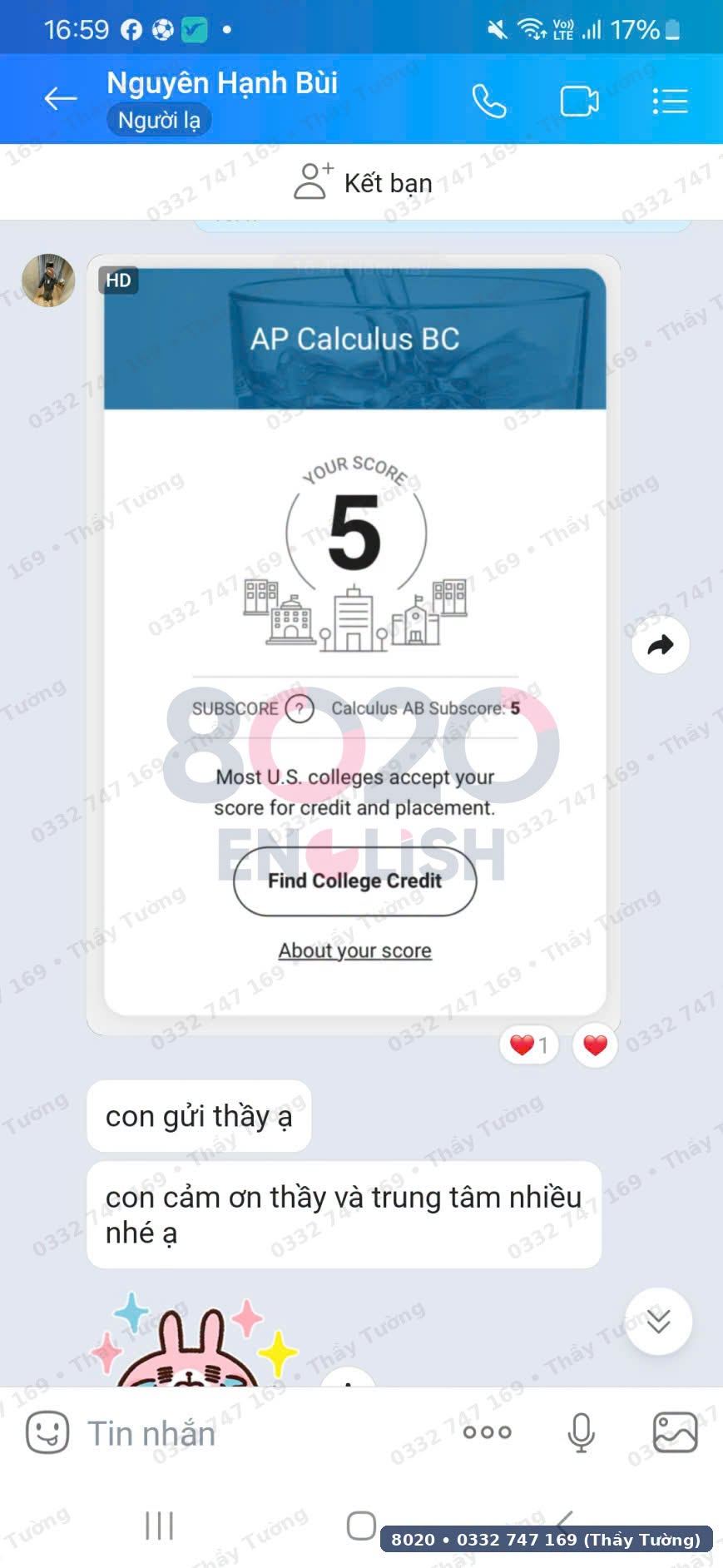
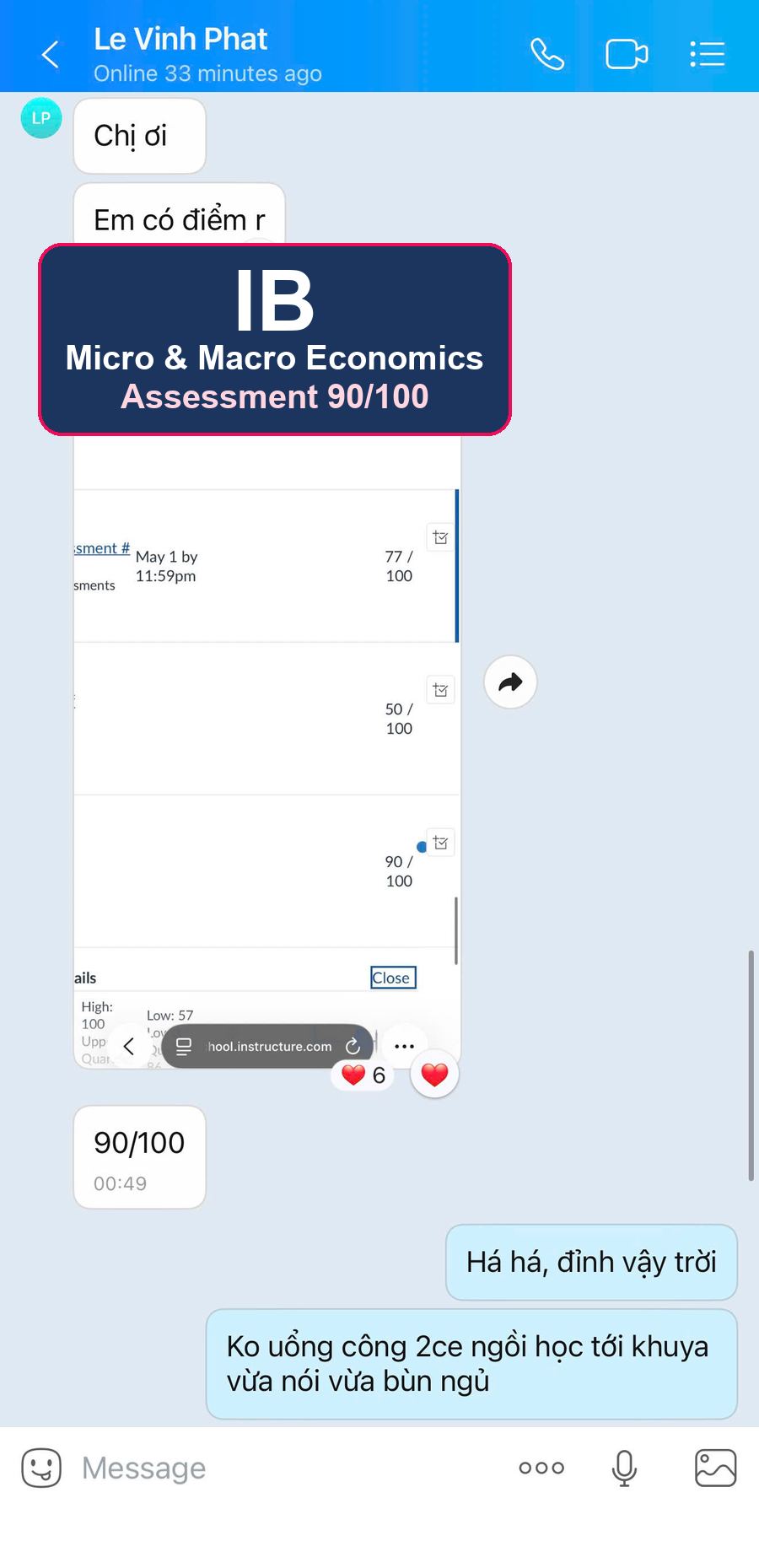
Score reports shared by students and parents. Tap a photo to enlarge.
The articles below are currently available in Vietnamese only.
7 chuyên đề cơ học, đề 40 MCQ + 4 FRQ chia 50/50. Calculus bắt buộc nhưng chỉ ở mức đạo hàm, tích phân cơ bản.
APAP Computer Science A học gì? Java, 4 unit và cấu trúc đề thiLập trình Java, 4 unit mới từ 2025–26, đề 42 MCQ + 4 FRQ thi máy 100%. So sánh thẳng với CS Principles.
APAP Psychology có dễ không? Sự thật sau format mới 2025Đề mới 5 unit, 75 câu MCQ, thêm AAQ và EBQ. Dễ vào nhưng chỉ 15% đạt điểm 5.
APAP Physics 1 học gì và có khó không? 8 unit, đề 2026 và cách học8 unit cơ học và chất lưu, đề 40 MCQ + 4 FRQ trong 3 giờ. Vì sao môn này phân cực điểm số và cách học đúng.
APAP Chemistry học gì, đề thi ra sao? Mổ xẻ 9 unit và format 20269 unit, 60 MCQ + 7 FRQ, được dùng máy tính cả hai phần — kèm 4 câu đề thật có lời giải.
APAP Calculus BC khác gì Calculus AB?BC bao trùm AB rồi cộng thêm chuỗi, tham số, polar. Bảng unit, 4 câu đề thật và cách chọn.
Take the free placement test and 8020 will pinpoint your gaps and place you in the right class with the right teacher. A practice area for each subject: a question bank by chapter, plus timed mock tests.