Home›IB
The IB Diploma (IBDP) is an international pre-university programme covering the final two years of secondary school, recognised by universities worldwide.
Real scores · Real teachers · Real results — teachers hold at least IELTS 8.0 or SAT 1500, and international programmes are taught by PhD and Master's holders.
Click each subject to see its topics, the structure of each SL and HL paper, the Internal Assessment, and how examiners mark by markband.
| Paper 1 — SL 1h30 (40%) · HL 2h (30%) — NO calculator | Section A: compulsory short questions; Section B: long questions — the emphasis is on algebraic manipulation, reasoning and proof. |
|---|---|
| Paper 2 — SL 1h30 (40%) · HL 2h (30%) — graphing calculator ALLOWED | Same Section A / Section B format, but the problems call for technology and modelling. |
| Paper 3 — HL only, 1h (20%) — calculator allowed | Two long problem-solving questions, guided step by step towards a general result. |
| Internal Assessment — 20% | Mathematical exploration: a 12–20 page written piece on a maths topic of your choice. |
Total SL 3 hours · HL 5 hours of written exams · NO calculator is allowed in Paper 1; a graphing calculator is required for Paper 2 and Paper 3.
| Section B — long question12–20 marks | Multi-part question (a)(b)(c) built around one scenario, with later parts using earlier results. |
|---|---|
| Paper 3 (HL) — problem solving55 marks for the two combined | Leads from specific cases to a general rule, then asks for a proof. |
| Internal Assessment — Exploration20 marks | Criteria: Presentation · Mathematical communication · Personal engagement · Reflection · Use of mathematics. |
| Paper 1 — SL 1h30 (40%) · HL 2h (30%) — calculator ALLOWED | Compulsory short questions across the whole syllabus, with an emphasis on application and interpretation. |
|---|---|
| Paper 2 — SL 1h30 (40%) · HL 2h (30%) — calculator ALLOWED | Extended questions based on real-world situations: modelling, statistics, finance. |
| Paper 3 — HL only, 1h (20%) — calculator allowed | Two extended questions using real data, requiring modelling and commentary on the results. |
| Internal Assessment — 20% | Mathematical exploration: a 12–20 page written piece on a topic of your choice. |
Total SL 3 hours · HL 5 hours of written exams · A graphing calculator is required in EVERY paper — quite unlike Math AA (where Paper 1 does not allow one).
| Paper 2 — case study question12–20 marks | Real data: choose a model, estimate parameters, make predictions and state the model's limitations. |
|---|---|
| Paper 3 (HL) — extended-response question55 marks for the two combined | Long guided question: data handling, hypothesis testing, interpretation in context. |
| Internal Assessment — Exploration20 marks | Same 5 criteria as Math AA; AI students usually choose a real-data topic. |
| Paper 1 — SL 1h30 · HL 2h — 36% | 1A multiple choice: 30 questions at SL, 40 at HL. 1B: 4 questions on data analysis and experimental skills (SL 25 marks, HL 35 marks). |
|---|---|
| Paper 2 — SL 1h30 · HL 2h30 — 44% | Section A: data response and short answers. Section B: one long essay chosen from two questions. SL 50 marks, HL 80 marks. |
| Internal Assessment — 20% | Scientific investigation: an individual study of ~3,000 words, marked by the teacher against 5 criteria and moderated by the IB. |
Total SL 3 hours · HL 4 hours 30 minutes of written exams · A calculator may be used in both Paper 1 and Paper 2.
| Paper 1B — data interpretation questionSL 25 · HL 35 marks | An unfamiliar experiment: describe trends, do calculations, identify limitations of the design. |
|---|---|
| Paper 2 Section AShort answer | Data-based and short questions across the whole syllabus, always including questions on experimental skills. |
| Paper 2 Section B — extended response~15 points | One extended question chosen from two, with several parts (a)(b)(c), requiring you to link knowledge across multiple topics. |
| Internal Assessment24 marks | Research question · method · data processing · conclusion and evaluation of limitations. |
| Paper 1 — SL 1h30 · HL 2h — 36% | 1A multiple choice: 30 questions at SL, 40 at HL. 1B: data-based questions linked to experimental skills. |
|---|---|
| Paper 2 — SL 1h30 · HL 2h30 — 44% | Short-answer and extended-response questions across the whole syllabus, including calculations and reaction mechanisms. |
| Internal Assessment — 20% | Scientific investigation of ~3,000 words, marked by the teacher against 5 criteria and moderated by the IB. |
Total SL 3 hours · HL 4 hours 30 minutes of written exams · A calculator and the Data booklet (constants, IR/NMR spectra, electrode potentials) may be used in both papers.
| Paper 1B — data interpretationBy level | Unfamiliar experimental data: process it, calculate uncertainties, and draw conclusions within the limits of the data. |
|---|---|
| Paper 2 — calculation questionBy point | Stoichiometry, concentration, thermochemistry, equilibrium, pH, electrochemistry — always write out the calculation. |
| Paper 2 — mechanism explanation questionBy point | Organic mechanisms (curly arrows), bonding and structure, periodic trends. |
| Internal Assessment24 marks | Individual investigation: research question, method, data processing and uncertainties, evaluation. |
| Paper 1 — SL 1h30 (45%) · HL 2h10 (40%) | Section A: short questions on system fundamentals, networks and computational thinking; Section B: long questions on algorithms and data structures. |
|---|---|
| Paper 2 — SL 1h (25%) · HL 1h20 (20%) | Questions on your chosen Option (Databases · Modelling and simulation · Web science · Object-oriented programming). |
| Paper 3 — HL only, 1h (20%) | Four compulsory questions based on a case study released before the exam. |
| Internal Assessment — SL 30% · HL 20% | Solution: a software product that solves a real problem for a specific client, accompanied by design documentation and a demo video. |
Total SL 2 hours 30 minutes · HL 4 hours 30 minutes of written exams · No calculator; pseudocode must follow the conventions in the IB's Approved notation.
| Paper 1 Section B — algorithm questionBy point | Write or trace pseudocode, complete a trace table, analyse complexity. |
|---|---|
| Paper 2 — Option-based questionBy point | Apply the principles of the option you studied to a new situation. |
| Paper 3 — case study (HL)30 marks | Study a real technology case in advance, then answer four questions; the last is an extended evaluation. |
| Internal Assessment34 marks | Criteria: Planning · Solution overview · Development · Functionality (video) · Evaluation. |
| Paper 1 — SL 1h (35 marks) · HL 2h (70 marks) — SL 25% · HL 30% | Case study paper: an unseen resource booklet (data, charts, diagrams) with analysis and evaluation questions. |
|---|---|
| Paper 2 — SL 2h (60 marks) · HL 2h30 (80 marks) — 50% at both levels | Section A: 40 marks of short-answer and data-based questions; Section B: structured extended response — SL answers 1 question out of 2, HL 2 out of 3. |
| Internal Assessment — SL 25% · HL 20% | Individual investigation: an individual study based on fieldwork or secondary data. |
Total SL 3 hours · HL 4 hours 30 minutes of written exams · A calculator may be used in both papers.
| Paper 1 — source analysis question35 / 70 marks | Read the data from a real environmental situation, then interpret, compare and evaluate. |
|---|---|
| Paper 2 Section B — structured essaySL 20 · HL 40 marks | Structured essay: outline the system, analyse the interactions, and evaluate solutions using real examples. |
| Internal AssessmentBy IB criteria | Investigation question, method, data processing, conclusion and evaluation. |
| Paper 1 — SL 1h30 · HL 2h — 36% | 1A multiple choice: 30 questions at SL, 40 at HL. 1B: data-based questions linked to experimental skills. |
|---|---|
| Paper 2 — SL 1h30 · HL 2h30 — 44% | Short and extended questions across the whole syllabus: physical reasoning, calculations, graph reading. |
| Internal Assessment — 20% | Scientific investigation of ~3,000 words, marked by the teacher against 5 criteria and moderated by the IB. |
Total SL 3 hours · HL 4 hours 30 minutes of written exams · A calculator and the Data booklet (formulae, constants) may be used in both papers.
| Paper 1B — data interpretationBy level | Experimental data: plotting/reading graphs, finding the gradient, estimating uncertainty. |
|---|---|
| Paper 2 — reasoning questionBy point | Explain a phenomenon using a law of physics; simply naming the law is not accepted. |
| Paper 2 — calculation questionBy point | Choose the formula from the Data booklet, substitute the values, state the units and comment on the size of the result. |
| Internal Assessment24 marks | Individual investigation: variables, method, data processing and uncertainties, evaluation. |
| Paper 1 — SL 1h15 (35%) · HL 2h15 (35%) | Based on a case study released before the exam; HL has an additional section requiring quantitative tools. |
|---|---|
| Paper 2 — SL 1h30 (35%) · HL 1h45 (30%) | Short, unseen, data-heavy scenarios: finance, human resources, marketing, operations. |
| Paper 3 — HL only, 1h15 (15%) | Source material on a social enterprise: identify the needs and barriers, and propose solutions. |
| Internal Assessment — SL 30% · HL 20% | SL: a 1,500-word research project. HL: a 1,800-word business research project based on primary and secondary sources. |
Total SL 2 hours 45 minutes · HL 5 hours 15 minutes of written exams · A calculator is required — Paper 2 always includes financial calculation questions.
| The 10-mark question at the end of each paper10 marks | Extended evaluation question: apply the tools you have learned (SWOT, Ansoff, force field analysis, BCG) to the actual data in the case. |
|---|---|
| Financial calculation questions2–4 marks per question | Break-even point, cash flow, financial ratios, depreciation, budgets — always state the formula and the currency unit. |
| Paper 3 (HL) — social enterprise25 marks | Identify a social need and the barriers facing the social entrepreneur, then make a reasoned recommendation. |
| Internal Assessment25 marks | Criteria: research question · sources · tools · analysis · conclusion and recommendations. |
| Paper 1 — 1h15 — SL 30% · HL 20% | One essay chosen from two questions, each in two parts: (a) explanation, 10 marks; (b) evaluation, 15 marks. |
|---|---|
| Paper 2 — 1h45 — SL 40% · HL 30% | Data response: a set of real source material with short questions, calculation questions and one 15-mark evaluation question. |
| Paper 3 — HL only, 1h45 (30%) | Policy paper: two quantitative and policy questions — calculate, then recommend and defend a policy. |
| Internal Assessment — SL 30% · HL 20% | Three commentaries of 800 words each, based on three real news articles from three different parts of the syllabus. |
Total SL 3 hours · HL 4 hours 45 minutes of written exams · A calculator may be used in Paper 2 and Paper 3.
| Paper 1 (b) — evaluation question15 marks | Requires both sides, real examples and a conclusion that takes a position; description alone is capped at 8–9 marks. |
|---|---|
| Paper 2 — 15-mark question15 marks | Evaluation is based ON the source material provided: you must cite the data in the paper, not write a generic model essay. |
| Paper 3 (HL) — policy questionBy point | Calculate (elasticity, tax, multiplier, balance), then choose a policy and defend it with the numbers you have just calculated. |
| Internal Assessment — commentary45 marks (3 × 14 + 3) | Criteria: Diagrams · Terminology · Application · Analysis · Evaluation. |
| Paper 1 — SL 1h30 (35%) · HL 2h10 (35%) | Geographic themes: SL students take 2 options, HL students 3 options; each option has short questions and one 10-mark essay. |
|---|---|
| Paper 2 — 1h15 — SL 40% · HL 25% | Geographic perspectives — global change: data-reading questions, short questions and one 10-mark essay. |
| Paper 3 — HL only, 1h (20%) | Global interactions: one 12-mark extended-response essay chosen from three questions, demanding synthesis. |
| Internal Assessment — SL 25% · HL 20% | A fieldwork report based on field data collected by the students themselves (SL 1,500 words, HL 2,500 words). |
Total SL 2 hours 45 minutes · HL 4 hours 25 minutes of written exams · A calculator may be used; Paper 2 always includes questions on reading maps, charts and data.
| 10-mark essay10 marks | Marked by markbands: structure, examples tied to the right named places, and a conclusion that answers the question directly. |
|---|---|
| Paper 3 (HL) — 12-mark question12 marks | Requires links across several topics and several spatial scales, with evaluation. |
| Internal Assessment — fieldwork25 marks | Fieldwork question · data collection methods · data presentation · analysis · conclusion and evaluation. |
| Paper 1 — 1h30 — SL 35% · HL 25% | Compulsory short questions on core content, questions applying it to an unseen extract, and one extended concept-based response. |
|---|---|
| Paper 2 — 1h30 — SL 35% · HL 25% | Apply knowledge to research: questions on the class practical and questions evaluating an unseen study. |
| Paper 3 — HL only, 1h45 (30%) | The three HL extensions — Culture · Motivation · Technology — examined through data. |
| Internal Assessment — SL 30% · HL 20% | Research proposal — the 2027 guide removes the requirement to run a real experiment. |
Total SL 3 hours · HL 4 hours 45 minutes of written exams · No calculator needed; the statistics content only requires interpreting results.
| Short-answer questions (SAQ)~9 points | State the concept, describe one study and link that study to the question — miss any one of the three and you lose the top markband. |
|---|---|
| Extended-response questions (ERQ)~22 points | Concept-based essay: explain, cite research, and EVALUATE (design, sample, ethics, generalisability). |
| Paper 2 — evaluating researchBy point | Read an unseen study, then discuss its method, sample, ethics and conclusions. |
| Internal Assessment24 marks | Research proposal: question, design, sample, variables, ethical considerations, planned analysis. |
Based on the IB subject guide for each subject.
Our international-programme teachers hold PhDs and Master's degrees in the very subject they teach.

Computer Science, at the #1-ranked US university for the field · 10 years living and working in the US, including time at Amazon · alumnus of the specialised Maths programme at Lê Hồng Phong

PhD with distinction · Master's with distinction, top 4% of the Faculty of Mathematics, Masaryk University (Czech Republic) · Bachelor's with distinction, top 2 in the Faculty of Mathematics, Ho Chi Minh City University of Education

Phổ thông Năng khiếu (High School for the Gifted, VNU-HCM) · Deutschlandstipendium and Odon Vallet scholarships · First Prize, National Student Physics Olympiad

Lecturer in Microeconomics and Macroeconomics at the University of Economics Ho Chi Minh City, HUTECH and Ho Chi Minh City University of Industry and Trade · AI and project management trainer at Viettel

Graduation thesis awarded Distinction · alumnus of the specialised Math class at Lê Hồng Phong · teaches Calculus and Statistics to AP students
IB is taught by SUBJECT and by YEAR, so 8020 offers one-on-one tutoring or small groups that follow the exact programme your school is teaching.
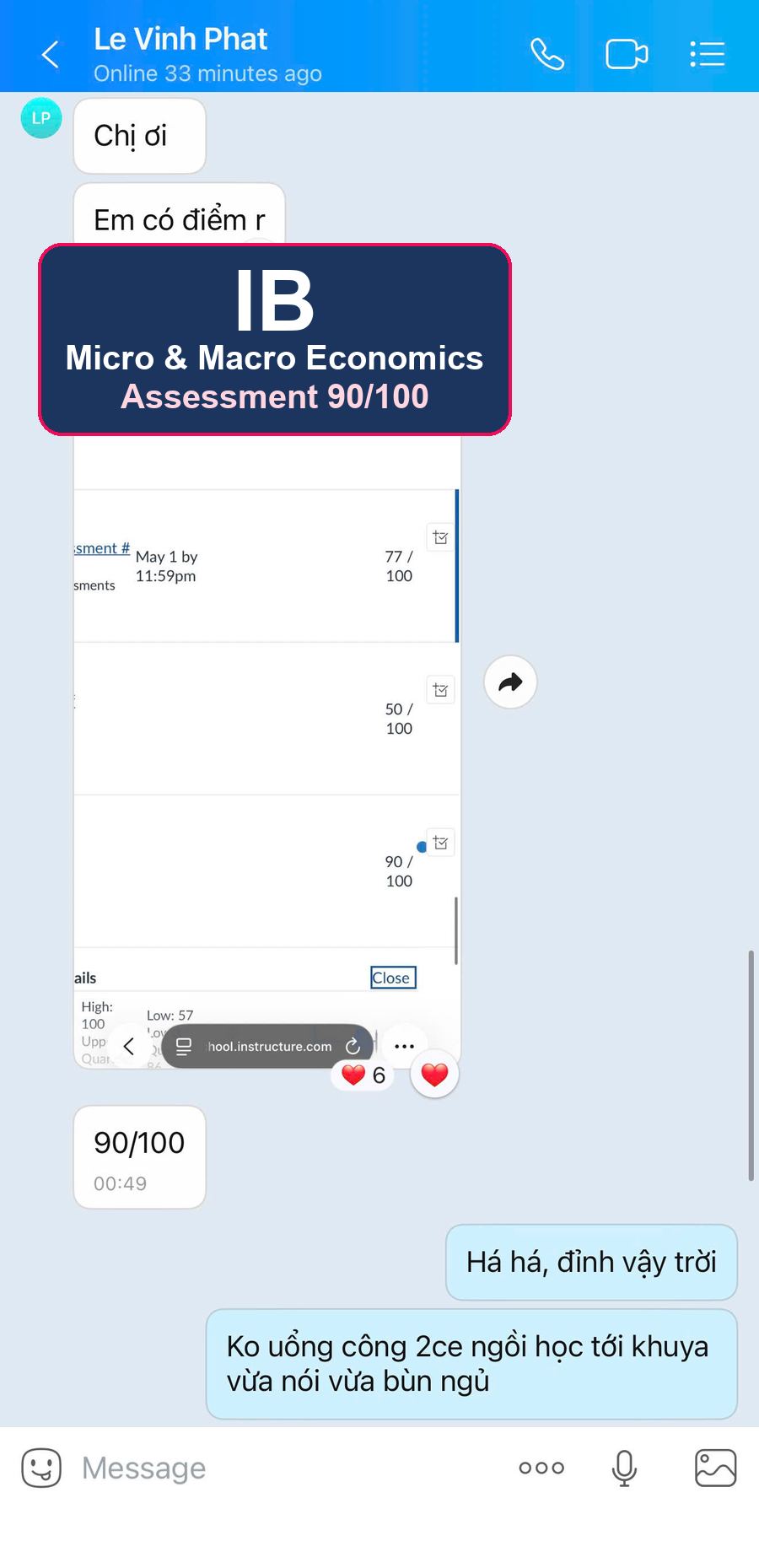
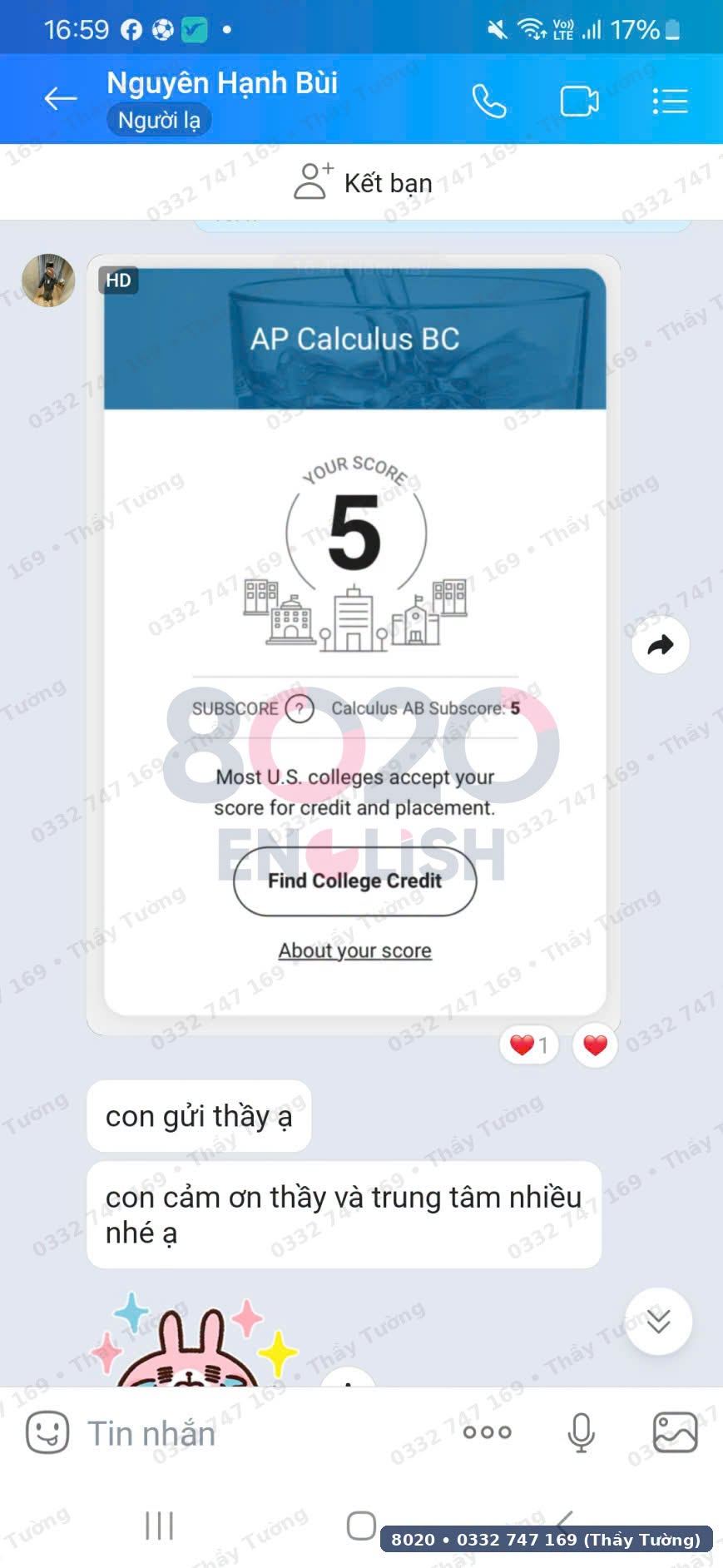
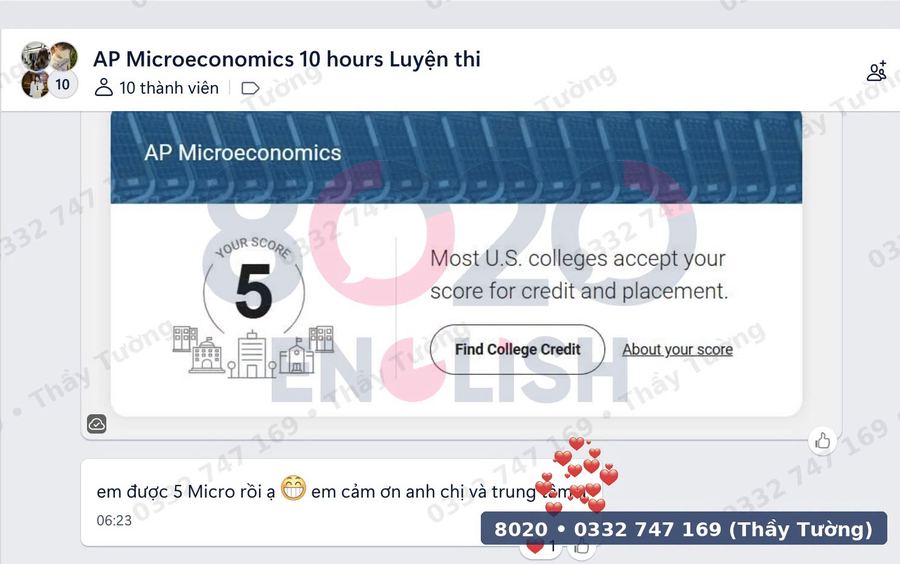
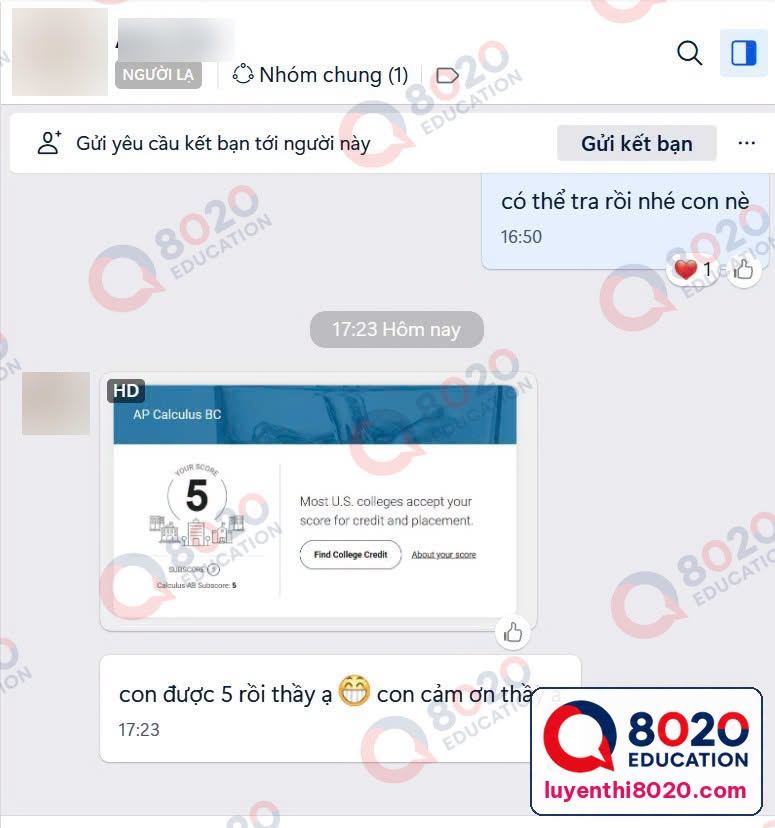
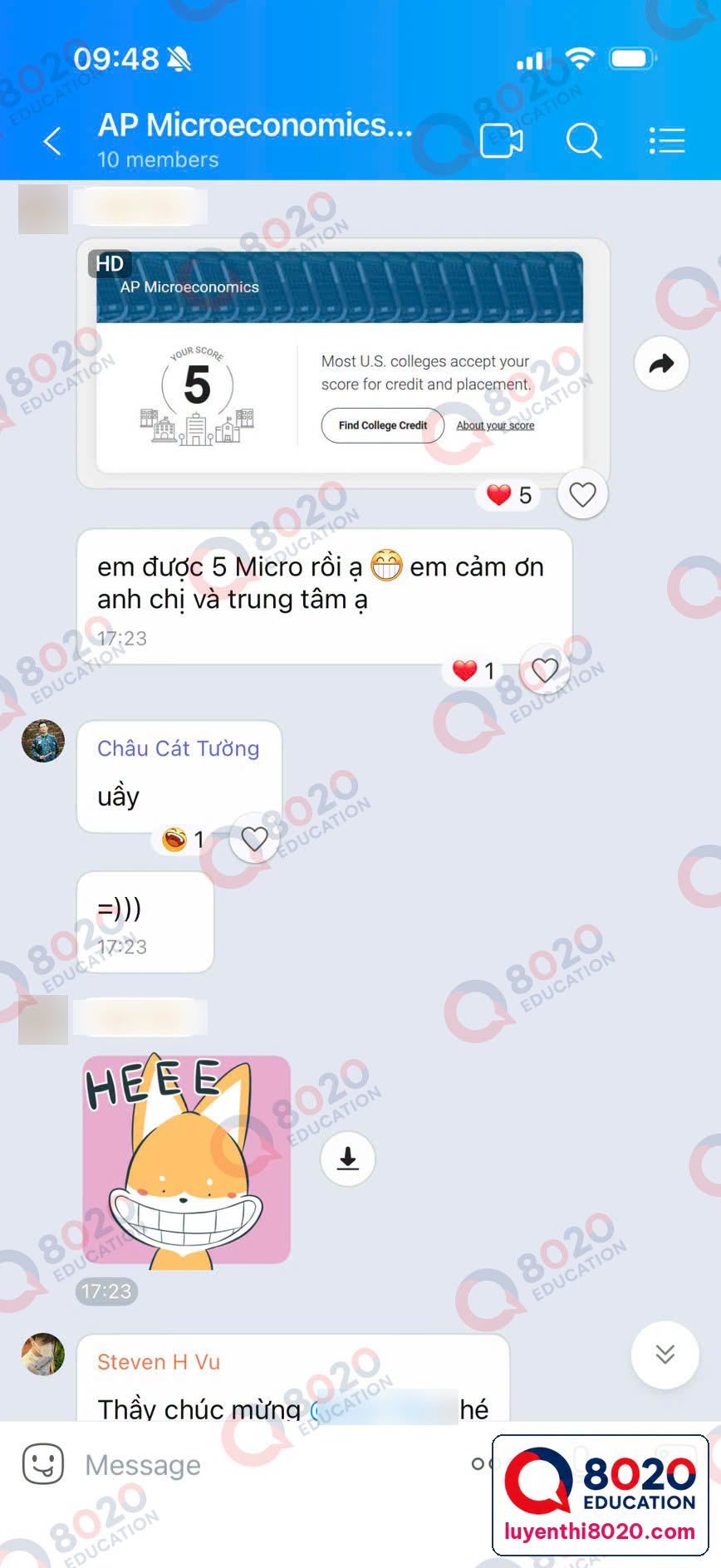
Score reports shared by students and parents (IB · AP). Tap a photo to enlarge.
The articles below are currently available in Vietnamese only.
Trung bình HL quanh 4,9/7, điểm 7 chỉ cần ~68% bài — phân tích 3 chỗ khó thật và cách học cho từng chỗ.
IBĐiểm IB 45 tính như thế nào — 6 môn, ma trận TOK × EE và điều kiện đậuBảng ma trận TOK × EE ra 0–3 điểm thưởng, ngưỡng đậu 24 và các điều kiện phụ hay bị bỏ sót.
IBIB Math AA hay Math AI — chọn môn nào, SL hay HL, theo ngành nào?Kỹ thuật, CS cần AA HL; kinh doanh, tâm lý hợp AI. Bảng so sánh 5 chủ đề + quy trình chốt trong 1 tuần.
IBIB Chemistry SL và HL khác gì nhau?HL = SL + 90 giờ AHL. Cùng 6 chủ đề, cùng 2 paper, khác độ sâu. Kèm 3 câu đề thật.
IBIB Diploma là gì? Cấu trúc 6 nhóm môn, phần core và thang điểm 456 môn + TOK + EE + CAS, tối đa 45 điểm. Trung bình toàn cầu 2025: 30,58.
IBIB Economics học gì? Nhìn hết 4 unit và cách chấm điểm4 unit, SL 2 paper, HL thêm Paper 3 tính toán 30%. Kèm 3 câu đề thật từ kho 8020.
Take the free placement test and 8020 will pinpoint your gaps and place you in the right class with the right teacher. From Math AA/AI to Economics — a question bank for every subject, marked automatically.