8020 English
Tiếng ViệtEnglish한국어中文

Home›Trần Đại Nghĩa Grade 6

Trần Đại Nghĩa Grade 6 entrance prep — Trọng Điểm 4 and Trọng Điểm 5

Trần Đại Nghĩa Secondary and High School admits Grade 6 students through a 90-minute aptitude assessment, most of it in English. The same paper format is also used for Hoa Lư, Trần Quốc Toản and Bình Thọ.

  • 90-minute assessment
  • 2026 cut-off score: 75.25/100
  • ~12 applicants per place

Real scores · Real teachers · Real results — teachers hold at least IELTS 8.0 or SAT 1500, and international programmes are taught by PhD and Master's holders.

Get advice on your Trần Đại Nghĩa Grade 6 study plan

Leave your phone number — 8020 will call you back the same day, with a free placement test.

Or message us on Zalo 0332 747 169 · 8020 uses this number only to advise you on courses.

The Trần Đại Nghĩa Grade 6 exam — what you need to know

What's tested
Part 1: 20 multiple-choice questions in English (30 minutes) on natural science, social science and general knowledge. Part 2: a 60-minute written paper covering English, Maths and logical thinking, and Vietnamese.
2026 figures
350 places, about 4,200 applications, and a cut-off score of 75.25/100 — the highest ever.
Exam dates
Held once a year in early summer (in 2026: 1 July), with results announced about a week later.
Why it is hard
The paper weaves several fields into a single question and asks it in English — question-spotting does not work; the foundations must be in place from Grade 4.
Who should study
Grade 4 and Grade 5 students in Ho Chi Minh City aiming for Trần Đại Nghĩa or other schools that admit by aptitude assessment.

Videos from 8020 classes

Clips from real 8020 classes and lessons — click to watch right here.

More on the 8020 EDUCATION YouTube channel ↗

Structure of the Trần Đại Nghĩa Grade 6 entrance assessment

One 90-minute paper marked out of 100, with two parts taken back to back. The format is the same as 2025; from 2026 the written part is split evenly: English 20 · Maths 20 · Vietnamese 20.

Part 1 — Multiple choice20 questions · 30 min · in EnglishNatural science, social science, everyday general knowledge.
Part 2 — Written response · Englishin a 60-minute written-response paperListening, reading comprehension and writing.
Part 2 — Written response · Maths and logical thinkingin a 60-minute written-response paperMulti-step problems requiring reasoning and a written solution.
Part 2 — Written response · Vietnamesein a 60-minute written-response paperReading comprehension and composition.

Why question-spotting does not work

  • One integrated paper covering several areas, not split by subject
  • Science and social studies questions asked in English
  • Written responses are marked on presentation and reasoning, not just the final answer

Read the full analysis of the 2026 exam structure →

Based on the official assessment paper of 1 July 2026 and the admissions notice from the Ho Chi Minh City Department of Education and Training.

Key-school prep curriculum — what students learn

Four strands of the Grade 6 entrance assessment, each split into Grade 4, Grade 5 and exam-practice modules. Content drawn from the syllabus and exercise bank 8020 currently teaches — tap a subject to see it.

8key-school prep levels 4.1–5.4
2.640weekly exercise questions
176weekly listening tasks
1590-minute mock test
Maths and logical thinkingPart 2 — written section (20 points, paper in English)34 topics

Grade 4 (levels 4.1–4.4)

  • Whole numbers up to millions, four operations, solving for x
  • Expressions with letters, order of operations
  • Converting units of mass, length, time
  • Angles; perpendicular and parallel lines
  • Averages
  • Fractions: simplifying, common denominators, comparing, four operations
  • Divisibility rules for 2, 5, 3, 9
  • Finding two numbers from sum–difference, sum–ratio, difference–ratio
  • Perimeter and area of rectangles, squares, parallelograms, rhombuses
  • Arithmetic sequences, age problems, tree-planting problems
  • Basic decimals, basic motion problems
  • Logical reasoning: number sequences, counting shapes, ordering

Grade 5 (levels 5.1–5.4)

  • Four operations with fractions and decimals, rounding
  • Converting units of length, mass, area, time
  • Percentages: discounts, price increases, interest rates
  • Area of triangles, trapeziums, circles
  • Volume of cuboids and cubes
  • Volume of an object from the rise in water level in a tank
  • Motion: meeting, catching up, upstream and downstream
  • Water-tap and joint-work problems
  • Temporary assumption method (chickens and dogs, counting legs)
  • Divisibility, remainders, arithmetic sequences
  • Mental shortcuts, estimation; mixed reasoning papers

Exam-practice module (TĐN Maths 1–4 banks)

  • Factors, multiples, prime numbers; GCD and LCM in word problems
  • Working backwards from the end, multi-step nested fractions
  • Successive percentage changes, ratios of three quantities
  • Logic grids, true–false statements, ranking
  • Pigeonhole (Dirichlet) principle, odd–even reasoning, last digits
  • Calendar, clock and cycle problems
  • Paper folding and cutting, nets of a cube
  • Area ratios of triangles, overlapping shapes, shaded regions
  • Counting paths, simple combinatorics
  • Reading charts and data tables; problems with too much or too little information
  • Writing out solutions step by step, with units

Question types in the paper

  • 6 fill-in-the-answer questions (2 points each) + 2 worked-solution problems (4 points each)
  • Maths problems written in English, word problems of two or more steps
  • Common: finding a missing number from the average, patterns in shape sequences
  • Common: working together vs. alone, working backwards, area of composite shapes
  • Common: two successive discounts, temporary assumption, rising water level
  • Common: calendars and cycles, a slow-running clock, page numbering

Materials 8020 currently uses

EnglishPart 2 — written section ① (20 points: listening · reading · writing)32 topics

Grade 4 (levels 4.1–4.4)

  • To be, personal pronouns, possessive pronouns
  • Plural nouns, articles a/an
  • Present simple, present continuous
  • Past simple: regular and irregular verbs
  • Comparatives, superlatives
  • must/mustn't, like + V-ing
  • Adverbs of frequency, some/any, how many/how much
  • Prepositions of time at/in/on
  • Future with will, be going to
  • -ing/-ed adjectives, adjectives and adverbs
  • Road signs, public places, road safety
  • Science and geometry vocabulary in English
  • Writing short messages and notes to a friend

Grade 5 (levels 5.1–5.4)

  • Present perfect with since/for
  • Past continuous
  • should, have to, may, might
  • First conditional
  • Everyday phrasal verbs (get up, turn on…)
  • Cloze and open cloze
  • Reading short passages
  • Vocabulary: environment, travel, transport
  • Maths vocabulary: add, subtract, multiply

Exam-practice module (TĐN English 1–3, Listening banks)

  • used to, relative clauses with who/which/that
  • Passive voice, introduction to reported speech
  • Word formation, linking words, guessing meaning from context
  • Sentence rewriting: too/enough, comparisons, passive
  • Form-completion listening: changes of mind, easily confused numbers
  • Listen, then calculate times and prices
  • Reading: True/False/Not Given, matching headings, inference
  • Writing a reply email that covers every point the task asks for
  • Describing a picture, telling a story from three pictures
  • Complete Listening · Reading · Writing mock tests

Question types in the paper

  • Listening, 8 questions: 3 recordings, each played twice (only in the Trần Đại Nghĩa paper)
  • Reading comprehension: 6 questions on 2 passages
  • Sentence rewriting / word formation: 2 questions
  • Write an email or short notice: 1 task, 4 points
  • Reading: details, word meaning in context, inferring implied meaning

Materials 8020 currently uses

Natural and social sciences in EnglishPart 1 — 20 multiple-choice questions (40 points, 30 minutes)35 topics

Grade 4 (levels 4.1–4.4)

  • Nutrient groups, the food pyramid, deficiency diseases
  • Food safety, the senses, body parts
  • Three states of water, the water cycle, dissolving
  • Air, combustion, respiration
  • Photosynthesis, roots–stems–leaves, food chains
  • Sound and noise; light and shadow
  • Temperature, heat conductors, heat insulators
  • Clean energy, saving electricity and water, protecting the environment
  • History: Văn Lang–Âu Lạc (ancient states), Bắc thuộc (Chinese rule), Ngô Quyền, the Đinh–Tiền Lê dynasties
  • History: the Lý dynasty moves the capital, the Trần dynasty, the Lam Sơn uprising
  • Geography: Hoàng Liên Sơn, Tây Nguyên (Central Highlands), the two great deltas
  • Geography: the central coast, Hà Nội, 54 ethnic groups
  • Major Vietnamese and international holidays

Grade 5 (levels 5.1–5.4)

  • Puberty, personal hygiene, disease prevention
  • Safety skills, emergency numbers 113/114/115
  • Physical and chemical changes
  • Solar energy, renewable energy, fuels
  • Electrical conductors and insulators, electrical safety
  • Pollination in flowers
  • Natural resources, forests, climate change, sea-level rise
  • History: the French invasion, the Cần Vương movement, Phan Bội Châu
  • History: the August Revolution (Cách mạng tháng Tám), the Declaration of Independence
  • History: Điện Biên Phủ, the resistance against the US, 30 April 1975, Đổi Mới (the 1986 reforms)
  • Geography: landforms, climate, seas and islands, Hoàng Sa–Trường Sa
  • Geography: population, agriculture, industry, transport
  • Continents, oceans, world heritage, children's rights

Exam-practice module (TĐN Science 1–4, History–Geography 1–3 banks)

  • Human body systems, life cycles of animals and plants
  • Forces, friction, simple machines, electric circuits, magnets
  • The Solar System, day and night, seasons, phases of the Moon
  • Designing fair tests, reading science charts
  • Maps: symbols, scale, latitude and longitude, time zones
  • Timelines, cause and effect, historical sources
  • Ancient civilisations: Egypt, Greece, Rome
  • Southeast Asia, Vietnam's UNESCO heritage sites
  • Festivals, craft villages, population and density

Question types in the paper

  • 20 multiple-choice questions × 2 points, entire paper in English
  • Mix in 8020 practice papers: 8 natural science · 6 social studies · 6 everyday life
  • No grammar questions: read the information, then reason and compare
  • Everyday life: bus timetables, weather reports, food labels
  • Everyday life: comparing promotions, first aid, teamwork etiquette
  • Natural science: fair tests, reading temperature graphs
  • Social studies: reading maps, timelines, comparing regions

Materials 8020 currently uses

Mock tests & periodic assessmentsFull paper — 90 minutes, out of 1005 topics

All levels

  • Placement test: 90-minute version and 45-minute short version
  • 5 high-difficulty mock tests
  • 10 Trần Đại Nghĩa mock tests with a Listening section
  • Week-10 end-of-term exam for each level: session A and session B
  • Writing marked by AI right after submission

Question types in the paper

  • Paper with Listening: 51 questions, 100 points, 4 questions marked by AI (22 points)
  • High-difficulty mock tests: 35–36 questions, 90 minutes, no Listening
  • End-of-term session A: Maths + Science, 30 questions, 45 minutes
  • End-of-term session B: English · History–Geography · Vietnamese · Listening, 37 questions, 55 minutes

Materials 8020 currently uses

Free gifted-prep books and papers — view and download now

8020 TIMO Olympiad — Primary 1 (lớp 1)9.0 MB · bilingual
8020 TIMO Olympiad — Primary 2 (lớp 2)9.3 MB · bilingual
8020 TIMO Olympiad — Primary 3 (lớp 3)8.7 MB · bilingual

Trần Đại Nghĩa Grade 6 exam prep teachers

The assessment covers Maths, logical reasoning, English, and science asked in English — each area is taught by a teacher with the matching background.

Châu Cát Tường, MBA — 8020
Châu Cát Tường, MBA
Academic Head · IELTS 8.5
Teaches: Thinking Maths · English

Master's, Western Sydney (Australia) · Talented Engineer Programme, Bách Khoa (Ho Chi Minh City University of Technology) · First Prize in Mathematics at city level, Mathematics specialist class at Lê Hồng Phong · over 10 years teaching IELTS and SAT

Dr. Nguyễn Phước Trường — 8020
Dr. Nguyễn Phước Trường
PhD in Mathematics · University of Klagenfurt (Austria)
Teaches: Maths and logical thinking

PhD with distinction · Master's with distinction, top 4% of the Faculty of Mathematics, Masaryk University (Czech Republic) · Bachelor's with distinction, top 2 in the Faculty of Mathematics, Ho Chi Minh City University of Education

Trần Hoàn Vũ, MSc — 8020
Trần Hoàn Vũ, MSc
Master's, Ho Chi Minh City University of Education · AP Math
Teaches: Maths and logical thinking

Graduation thesis awarded Distinction · alumnus of the specialised Math class at Lê Hồng Phong · teaches Calculus and Statistics to AP students

Dr. Hùng — 8020
Dr. Hùng
PhD in Mathematics · University of Münster (Germany)
Teaches: Thinking Maths · Science

PhD magna cum laude, University of Münster (Germany) and University of Tours (France) · MSc in Applied Mathematics, Sorbonne Paris Nord, très bien · lecturer at the Industrial University of Ho Chi Minh City · Le Hong Phong High School for the Gifted, maths stream

Phạm Trung Hiếu, MSc — 8020
Phạm Trung Hiếu, MSc
Master's, TU Munich (Germany) · IELTS 8.0
Teaches: Science in English

Phổ thông Năng khiếu (High School for the Gifted, VNU-HCM) · Deutschlandstipendium and Odon Vallet scholarships · First Prize, National Student Physics Olympiad

English teachers

Nguyễn Nhật Nam — 8020
Nguyễn Nhật NamIELTS 8.5
Nguyễn Khanh — 8020
Nguyễn KhanhIELTS 8.0
Nguyễn Đan Vy — 8020
Nguyễn Đan VyIELTS 8.0

Meet the full 8020 teaching team →

Trần Đại Nghĩa Grade 6 levels at 8020

Two STEM-standard classes by grade, Online on weekday evenings or In-person at Chợ Quán at weekends. Homework is marked on the TDN8020 platform, written-response questions included.

Group class

  • Trọng Điểm 4 (Grade 4 key-school prep)Grade 4 studentsOnline
  • Trọng Điểm 5 (Grade 5 key-school prep)Grade 5 studentsOnline

Small-group class

  • Trọng Điểm 4 (Grade 4 key-school prep)In-person at Chợ Quán, weekendsIn-person at Chợ Quán
  • Trọng Điểm 5 (Grade 5 key-school prep)In-person at Chợ Quán, weekendsIn-person at Chợ Quán

Private tutoring

  • One-on-one tutoringA personalised study plan, built around the student's schedule · suits students joining late, mid-yearOnline / In-person at Chợ Quán

Earlier levels

  • Thinking Maths Grades 1–3The bilingual English–Vietnamese 8020 THINK MATH series, built on the Singapore method — the foundation for Trọng Điểm 4.View →

One-on-one tutoring program for Grade 6 entry to Trần Đại Nghĩa

One teacher with one student, on a study plan built from scratch around the placement test. Suited to children who join late, mid-year, who are well behind in one subject, or whose family needs its own schedule.

Personalised study planTeaching exactly where your child has gaps: Thinking Math and logic, English, natural and social science in English.
Schedule built around your familyChoose your own class days and times, with the student's schedule taking priority. Online nationwide or In-person at Chợ Quán.
Personal, hands-on feedbackEvery written-response answer is corrected point by point by the teacher during the lesson; homework is marked on the TDN8020 practice platform.
Parents kept in the loopRegular mock tests in the exact 90-minute format, with section-by-section scores sent to parents after each round.

Process

  1. 1Free placement test
  2. 2Consultation and a personalised study plan
  3. 3Assigning your teacher and timetable
  4. 4One-on-one lessons, practice on TDN8020
  5. 5Regular mock tests with results reported

Results reported by Trọng Điểm parents

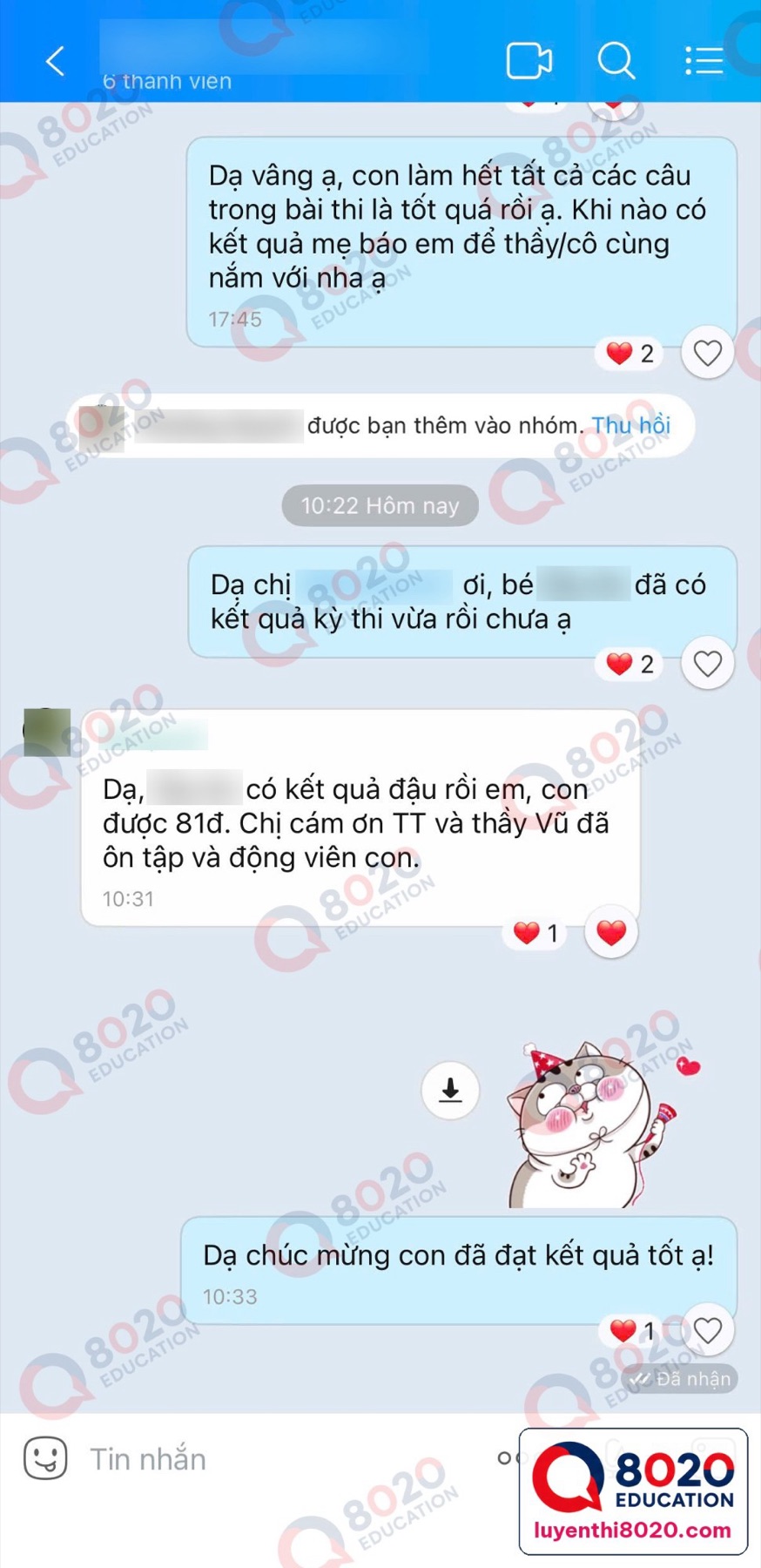
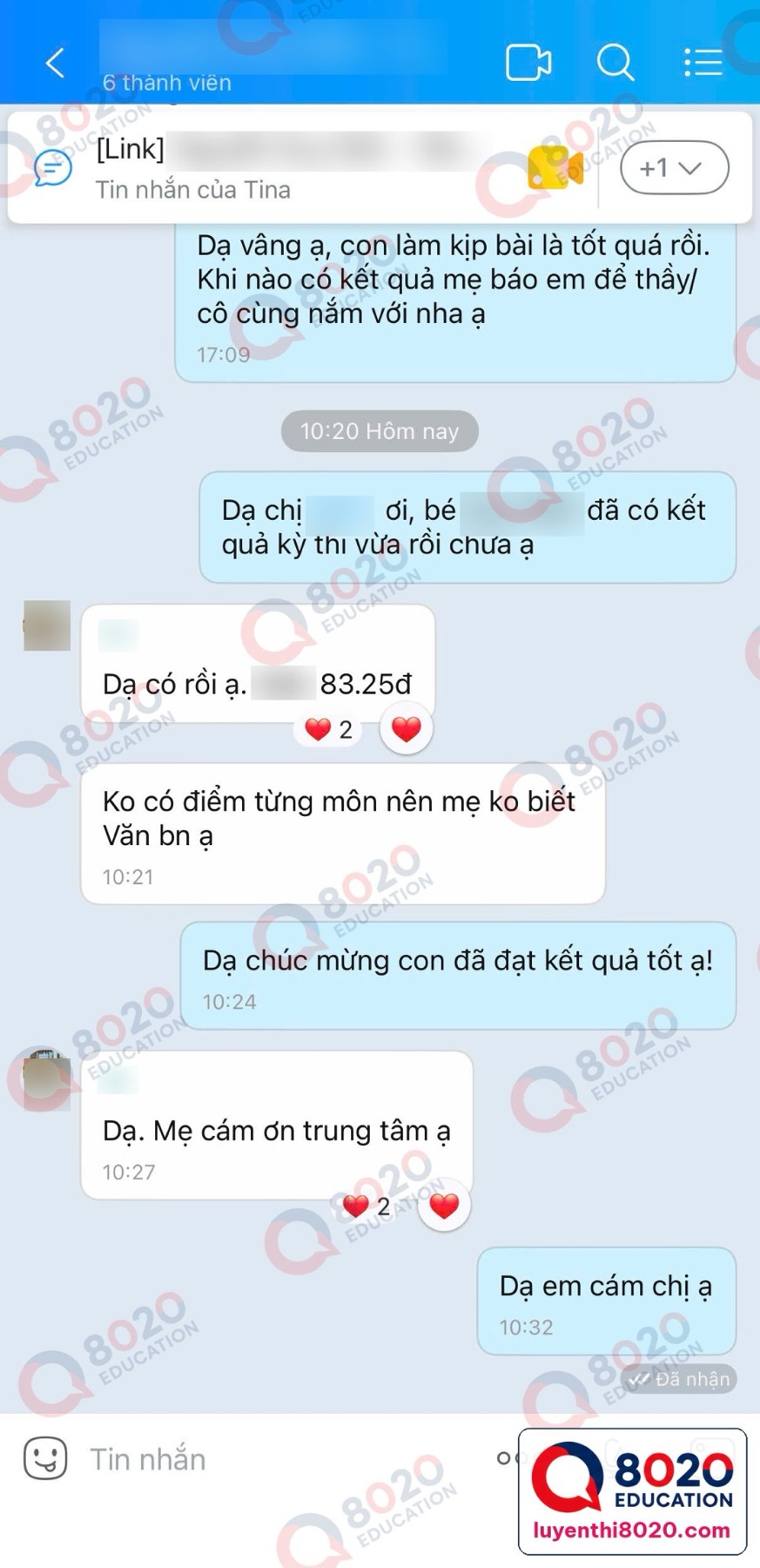
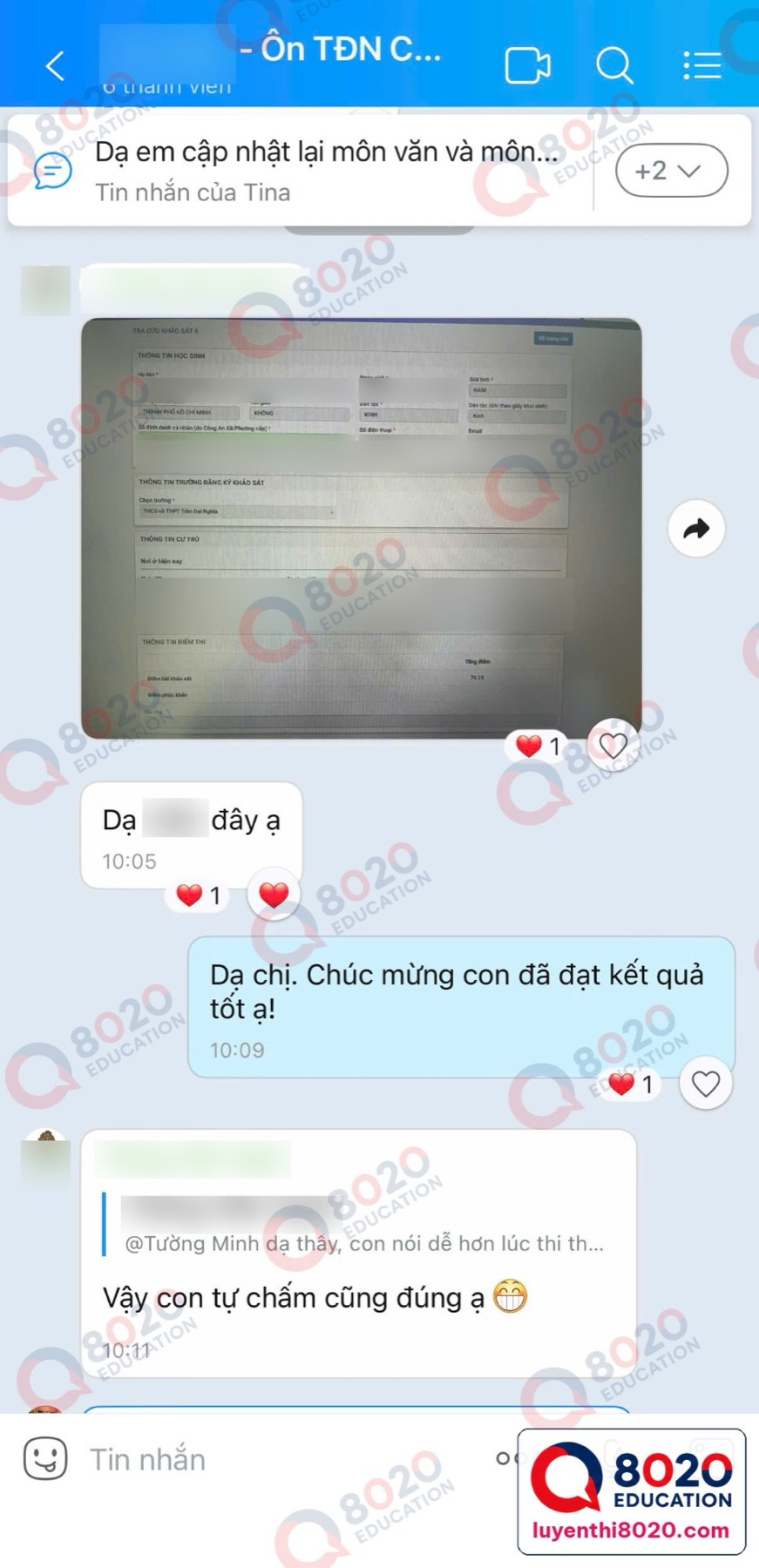
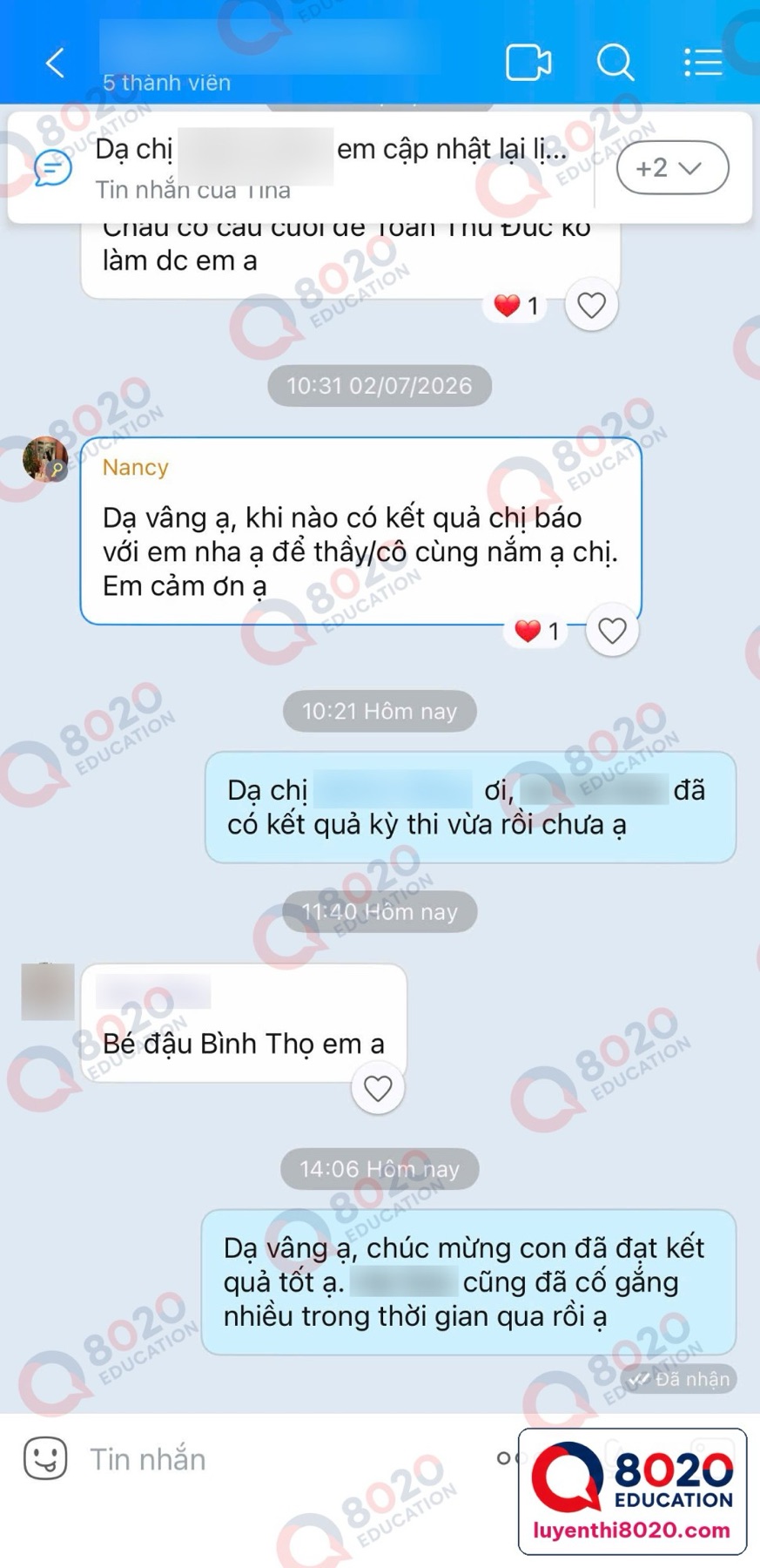
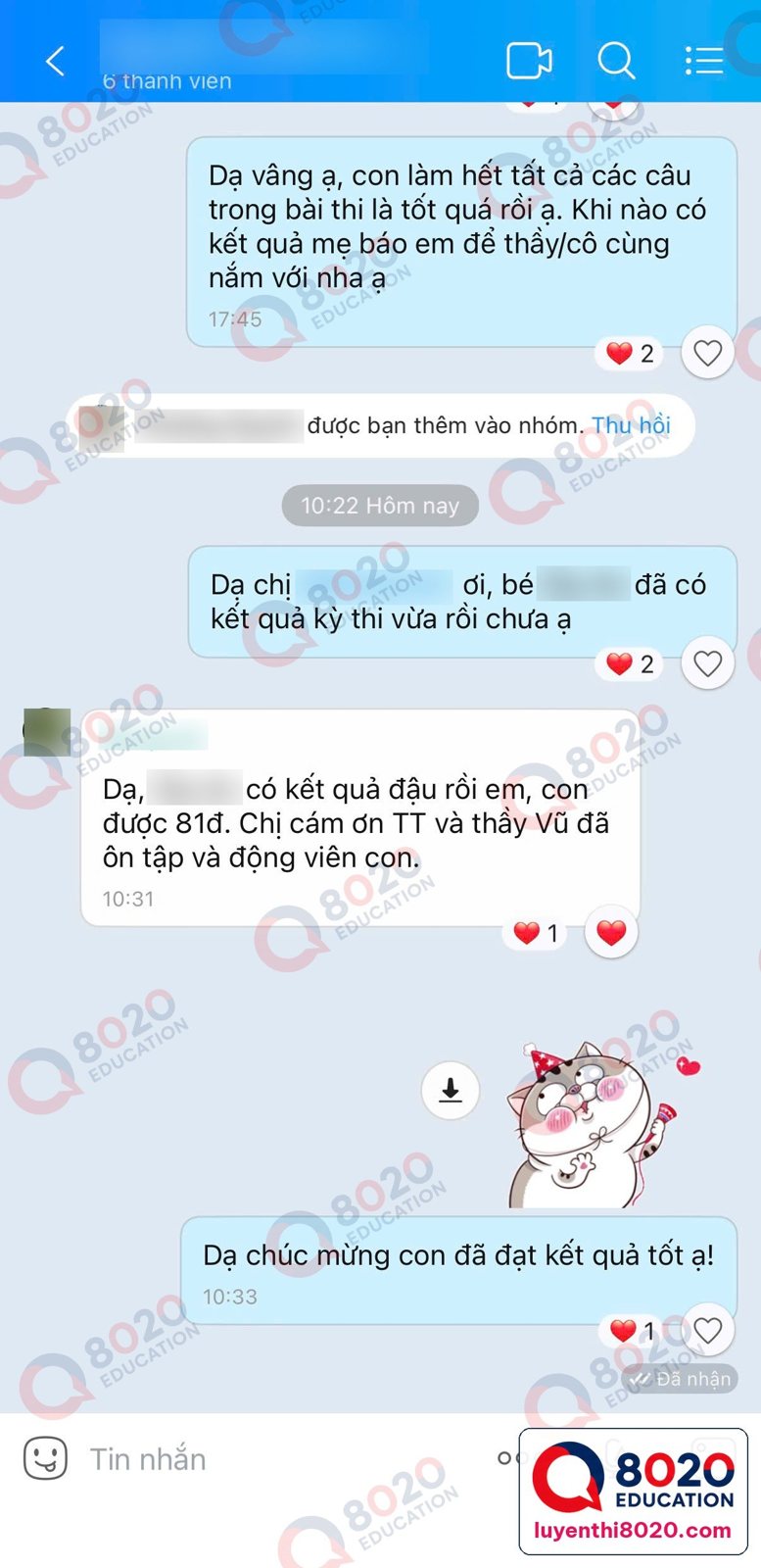
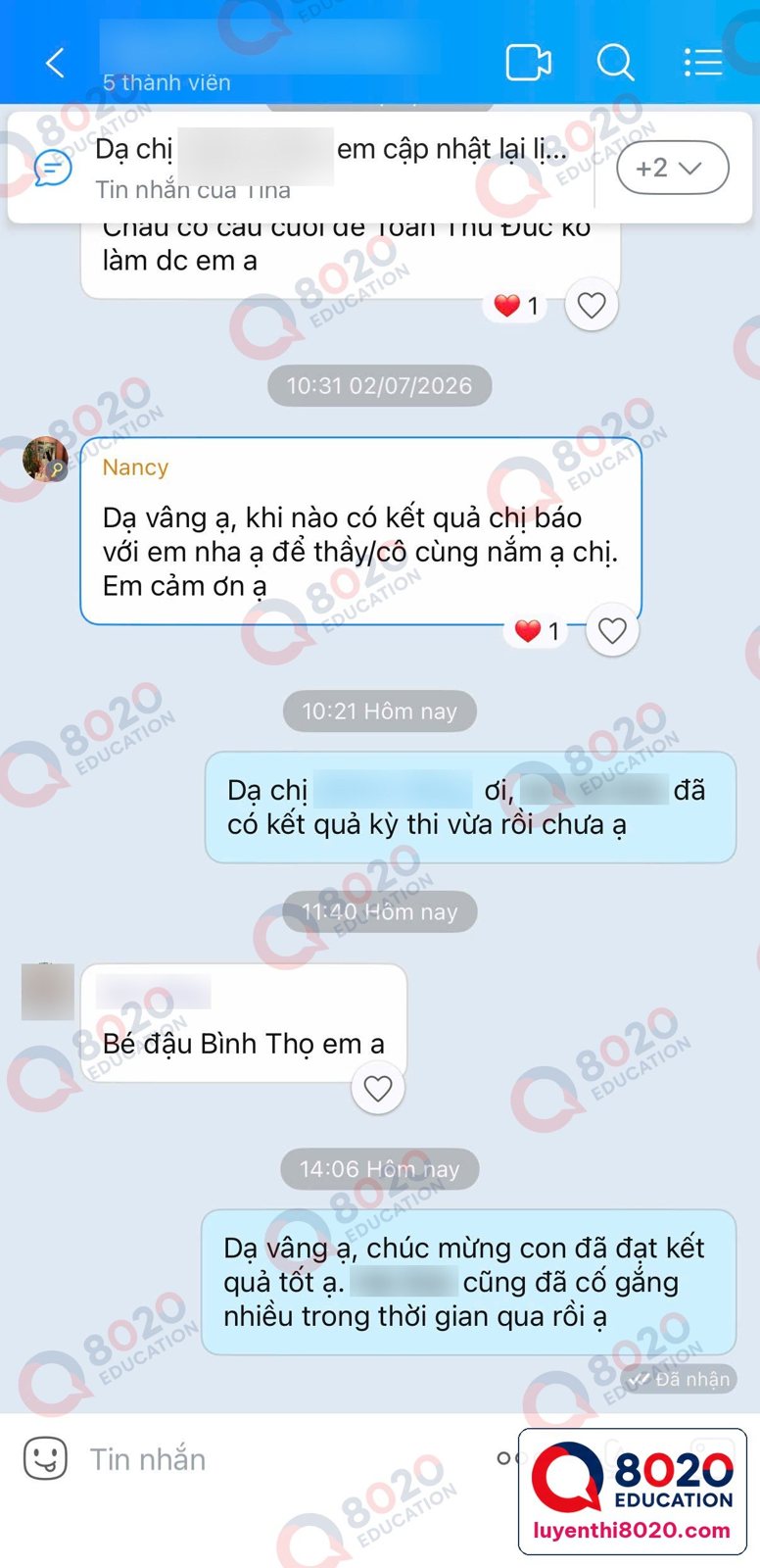
Messages sent to us after the Grade 6 entrance exam — assessment scores and the schools the children got into, with names hidden. Tap an image to see it clearly.

FAQ

What is in the Tran Dai Nghia Grade 6 entrance test?

One 90-minute test scored out of 100, in two parts taken back to back. Part 1 is 20 multiple-choice questions in English in 30 minutes on natural science, social science and general knowledge. Part 2 is a 60-minute written section; from 2026 it is split evenly into English 20 points, maths and logical thinking 20 points, and Vietnamese 20 points.

What were the 2026 cut-off score and competition ratio?

In 2026 the school had 350 places and received about 4,200 applications, a ratio of about 1 in 12. The cut-off score was 75.25/100, the highest ever. The test is held once a year at the start of summer (on 1/7 in 2026), and results are announced about a week later.

In which grade should my child start preparing?

The test blends several subjects into one paper and asks science questions in English, so it cannot be crammed; children need a foundation from Grade 4. At 8020, the Grade 4 and Grade 5 key-school prep classes follow the entrance test format exactly. Children in Grades 1–3 can build a foundation first with the bilingual 8020 THINK MATH thinking-maths series.

How do the key-school prep classes at 8020 work?

There are two STEM-standard classes by grade, held online on weekday evenings or in person at Chợ Quán at weekends. Homework is marked on the TDN8020 site, written answers included. Each part of the test is taught by a teacher with the right background: maths and logical thinking, English, and science asked in English. The same test format is also used by Hoa Lu, Tran Quoc Toan and Binh Tho.

What if my child joins mid-year or is far behind in one subject?

There is a 1-1 programme: one teacher with one student, with a plan built from the placement test and focused on exactly the gaps your child has. The family chooses the schedule, online nationwide or in person at Chợ Quán. After every mock test in the 90-minute format, the score for each part is sent to parents.

Articles about Trần Đại Nghĩa Grade 6 · 29 posts

The articles below are currently available in Vietnamese only.

Trọng điểmKho đề thi vào lớp 6 Trần Đại Nghĩa các năm: đề + đáp án 2022–2026, bảng 2018–2026

Đề chính thức 2022–2026 kèm đáp án PDF miễn phí, lời giải 2026, làm online đề cùng khung; bảng hình thức tuyển và điểm chuẩn từng năm.

Trọng điểmCách tính điểm khảo sát lớp 6 2026, quy chế phòng thi, tra cứu điểm và phúc khảo

Thang 100 = 40 + 20 + 20 + 20, ví dụ tính thử, máy tính cầm tay, tra điểm, phúc khảo và checklist ngày thi.

Trọng điểmTrường THCS-THPT Trần Đại Nghĩa: có phải trường chuyên, công hay tư, học phí, ở đâu

Công lập, phường Sài Gòn, miễn học phí, bán trú, 350 chỉ tiêu lớp 6, so với 4 trường khảo sát còn lại.

Trọng điểmChuẩn bị khảo sát vào lớp 6 2027 từ học kỳ 2 lớp 5: kế hoạch 6 tháng theo từng tháng

Còn ~31 tuần tới kỳ khảo sát 2027. Bảng việc từng tháng, cách đọc đề chẩn đoán và giữ điểm học bạ.

Trọng điểmNgữ pháp tiếng Anh ôn thi vào lớp 6 trường trọng điểm: 12 chủ điểm theo đề khảo sát, bài tập có đáp án và lịch 8 tuần

Quy tắc ngắn, 24 bài tập có đáp án, bảng chủ điểm theo đề khảo sát 2026 và lịch ôn 8 tuần.

Trọng điểmLớp 6 tích hợp là gì? Điều kiện vào lớp 6 tích hợp, tuyển sinh, học phí ở TP.HCM

Đề án 5695, điều kiện tiếng Anh, lịch 2026, khoản thu và bảng so với lớp thường, 5 trường khảo sát.

View the full 8020 blog →

Not sure where to start with Trần Đại Nghĩa Grade 6?

Take the free placement test and 8020 will pinpoint your gaps and place you in the right class with the right teacher. Exercises by grade and by subject, plus mock tests — written responses are marked too.

About our other exams

Book a Trần Đại Nghĩa Grade 6 consultation