Line graph — Nitrogen oxide (NOx) emissions from four types of vehicle
📄 Bài mẫu band 8–9
| Introduction | Paraphrase: lượng NOx trung bình (gam/km) do xe xăng, xe diesel, xe buýt và xe tải thải ra ở các tốc độ từ 10 đến 130 km/h. |
| Overview | Overall: cả bốn loại xe đều theo đường chữ U — thải ít nhất ở tốc độ trung bình, nhiều nhất ở hai đầu; xe buýt và xe tải thải nhiều hơn hẳn hai loại ô tô con. Không số liệu. |
| Body 1 | Ở 10 km/h: Bus 11,8, Lorry 9,6. Đáy ở 70 km/h: khoảng 5,6 và 5,9 (Lorry bắt đầu cao hơn). Ở 130 km/h: Lorry 13,1, Bus 10,9 — chênh 2,2 gam. |
| Body 2 | Diesel car: 3,6 → khoảng 2 (70 km/h) → 4,3. Petrol car: 2,1 → gần 1 → 2,4. Diesel thải khoảng gấp đôi petrol; mức cao nhất của diesel (4,3) vẫn dưới mức thấp nhất của hai xe lớn. |
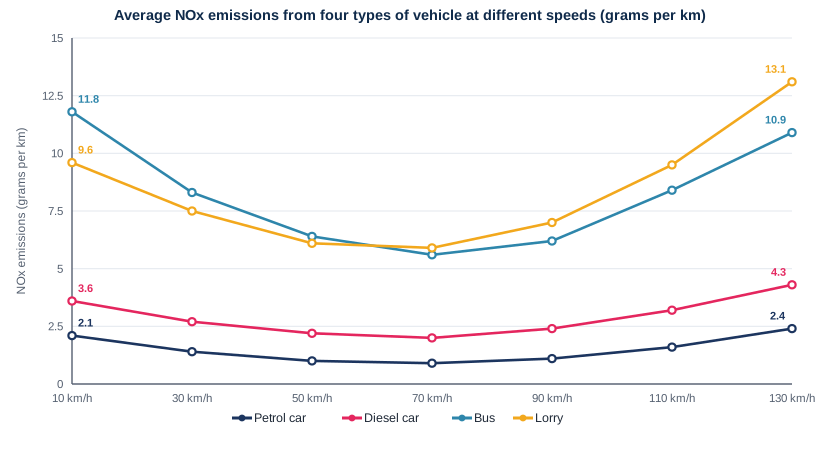
The line graph illustrates how much nitrogen oxide, in grams per kilometre, petrol cars, diesel cars, buses and lorries emit on average at speeds from 10 to 130 km/h.
Overall, emissions from all four vehicle types trace a U-shaped curve, being lowest at moderate speeds and highest at the two extremes. Buses and lorries are far heavier polluters than either type of car at every speed.
At 10 km/h the bus is the worst offender, emitting 11.8 grams against the lorry's 9.6. Both figures fall as speed increases and bottom out at 70 km/h, at roughly 5.6 and 5.9 grams respectively, which makes the lorry marginally the dirtier from this point on. Beyond that speed emissions climb again, and more steeply for the lorry, which reaches 13.1 grams at 130 km/h, 2.2 above the bus's 10.9.
The two cars follow the same pattern at a much lower level. Diesel cars produce 3.6 grams at the lowest speed, about 2 at 70 km/h and 4.3 at the highest, while petrol cars, the cleanest vehicles throughout, go from 2.1 to just under 1 gram and back up to 2.4. The diesel car thus emits roughly twice as much as its petrol equivalent. Even at its dirtiest, it stays below the lowest figure for either heavy vehicle.
| a U-shaped curve | đường cong hình chữ U |
| far heavier polluters | nguồn gây ô nhiễm nặng hơn nhiều |
| the worst offender | thủ phạm (gây ô nhiễm) nặng nhất |
| bottom out at | chạm đáy ở |
| Beyond that speed | Vượt quá tốc độ đó |
| follow the same pattern | đi theo cùng một kiểu biến thiên |
| roughly twice as much | khoảng gấp đôi |