Bar chart — Railway usage in four countries, 1990-2010
📄 Bài mẫu band 8–9
| Introduction | Paraphrase: quãng đường đi tàu trung bình mỗi người mỗi năm (km) ở Japan, France, Italy, UK tại ba mốc 1990, 2000, 2010. |
| Overview | Overall: người Nhật đi tàu nhiều nhất, vượt xa ba nước còn lại và hầu như không đổi; France và nhất là UK tăng, còn Italy kết thúc gần đúng mức ban đầu. Không số liệu. |
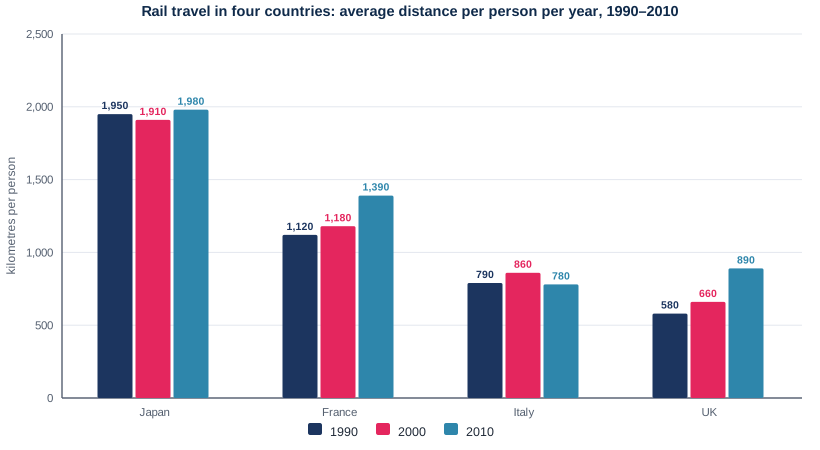
| Body 1 | Japan 1,950 → 1,910 → 1,980 km (dao động trong 70 km); France 1,120 → 1,180 → 1,390 km, vẫn kém Japan khoảng 590 km năm 2010. |
| Body 2 | UK 580 → 660 → 890 km (tăng hơn một nửa, năm 1990 chưa bằng một phần ba Japan); Italy 790 → 860 → 780 km; UK từ kém Italy 210 km thành hơn 110 km. |
The bar chart compares how far the average person travelled by train each year, in kilometres, in Japan, France, Italy and the UK in 1990, 2000 and 2010.
Overall, the Japanese were the heaviest rail users by a wide margin throughout, and their figure hardly changed. Rail travel per head grew in France and especially the UK, whereas Italy finished almost exactly where it began.
In Japan, the average distance stood at 1,950 km in 1990, dipped to 1,910 km in 2000 and recovered to 1,980 km in 2010, thus remaining within a narrow band of 70 km. In second-placed France, growth was slow at first, from 1,120 to 1,180 km, but gathered pace in the following decade to reach 1,390 km, still some 590 km short of the Japanese figure.
The two remaining countries swapped positions. The UK had the lowest figure in 1990, at 580 km, less than a third of Japan's, yet this rose to 660 km and then sharply to 890 km, an overall increase of more than half. The Italian average went up from 790 to 860 km before falling back to 780 km, marginally below its starting point. As a result, Britons, who had travelled 210 km less than Italians in 1990, were 110 km ahead by 2010.
| the heaviest rail users | những người đi tàu nhiều nhất |
| stood at | ở mức |
| within a narrow band | trong một biên độ hẹp |
| gathered pace | tăng tốc |
| swapped positions | đổi vị trí cho nhau |
| falling back to | tụt trở lại mức |
| marginally below its starting point | thấp hơn mức ban đầu một chút |